Leadership, Governance & the Sustainability Mandate
Module overview
This module considers sustainability through the lens of governance within performance arts organisations. It reflects on how sustainability is shaped by the relationship between strategic oversight and operational expertise, and by how decisions, authority, and priorities interact over time. As Performance art organisations and cultural institutions are increasingly asked to demonstrate alignment between values and practice, sustainability becomes closely connected to questions of organisational legitimacy, resilience, and civic responsibility.
The module is intended for board members, executives, senior managers, and cultural leaders who influence strategic direction, policy, and resource allocation. It focuses on how governance structures, planning processes, and organisational culture enable or constrain sustainable practice.
Aims, Objectives & Learning Outcomes
🎯 Module Aims
This module aims to:
- Position sustainability as a shared concern of governance and operational practice.
- Examine how leadership structures and decision-making processes shape sustainable outcomes.
- Explore the relationship between organisational values, responsibility, and long-term resilience.
🏆 Learning Outcomes
On completion of this module, participants should be able to:
- Distinguish between the complementary roles of governance and operational practice in shaping sustainable outcomes.
- Analyse how strategic planning, policy, and resource allocation influence sustainability.
- Identify the relevance of the UN Sustainable Development Goals (SDGs) to everyday organisational decisions.
- Assess how organisational culture and behaviour affect the embedding of sustainability.
- Translate sustainability intentions into concrete governance-level commitments.
Introduction
Art has always reflected the qualities, ideals and challenges of the world around us. As chronic environmental issues escalate and their impact on ecosystems and societies become more and more pressing, it is not at all surprising that sustainability has become one of the defining tests of leadership in the cultural sector. Organisations such as theatres and festivals in the performance arts fields are no longer evaluated solely on their artistic accomplishments; they are increasingly judged on whether their governance behaviours align with social and environmental responsibility. Beyond generating innovative artistic work, if an organisation’s internal decisions contradict its stated ethics, its credibility erodes and it’s messaging weakens. Sustainability now sits at the core of governance because it shapes an organisation’s legitimacy, risk profile, and long-term resilience.
Performance arts organisations are civic actors, not neutral producers of entertainment. Their decisions about programming, partnerships, resource allocation, staff structure, and audience engagement shape cultural meaning and social values. Sustainability therefore should not be considered an operational add-on; it is an institutional stance. When a performance art organisation chooses how it pays people, what it builds, the materials it uses, the timeframes it imposes, and the partnerships it enters, it makes sustainability decisions whether consciously or not. These decisions accumulate into a visible institutional ethic.
If sustainability never appears in leadership discussions, the organisation has already decided it does not matter regardless of what its public language claims.
External pressures now demand that performance art organisations demonstrate responsibility through structural changes and long-term strategies. Funders, civic partners, and audiences increasingly expect alignment between values and governance. Treating sustainability as something to be “considered later” is no longer viable. Organisations that fail to adapt risk becoming strategically irrelevant, reducing their strength in inter-organisational structures that shape sector activity.
Embedding sustainability in an organisation requires top down and bottom up approaches. Boards and executives play different roles, but their decisions meet in practice. Boards set direction and boundaries. Executives turn those directions into operational rules, timelines and expectations. Staff work within the conditions that leadership creates and signal where those conditions are workable. Sustainability takes hold only when governance decisions, managerial practice and daily work reinforce the same priorities. When they do not, responsibility shifts informally to individuals without the authority or resources to sustain it.
If sustainability depends on the right person being in the building, it is not a governance structure,it is a personality risk.
Performance art organisations that achieve sustainable transformation do not begin with greater conviction but with clarity about how decisions are made. When it is clear who decides what, how decisions enter planning, and what is expected across the organisation, it becomes possible to build systems that outlast motivation instead of relying on motivated individuals. The Sustainable Culture Toolkit demonstrates that when responsibilities are allocated transparently, expectations articulated, and processes resourced, sustainability ceases to be an aspiration and becomes the natural consequence of decision-making.
Performance art organisations operate within production models that have developed over many years. These models include scheduling practices, design and build processes and procurement routines that were shaped for artistic and logistical needs rather than for sustainability. Adjusting them requires organisational decisions instead of artistic skill. The Sustainable Culture Toolkit focuses on how planning, budgeting and day-to-day operations can evolve while preserving artistic work.
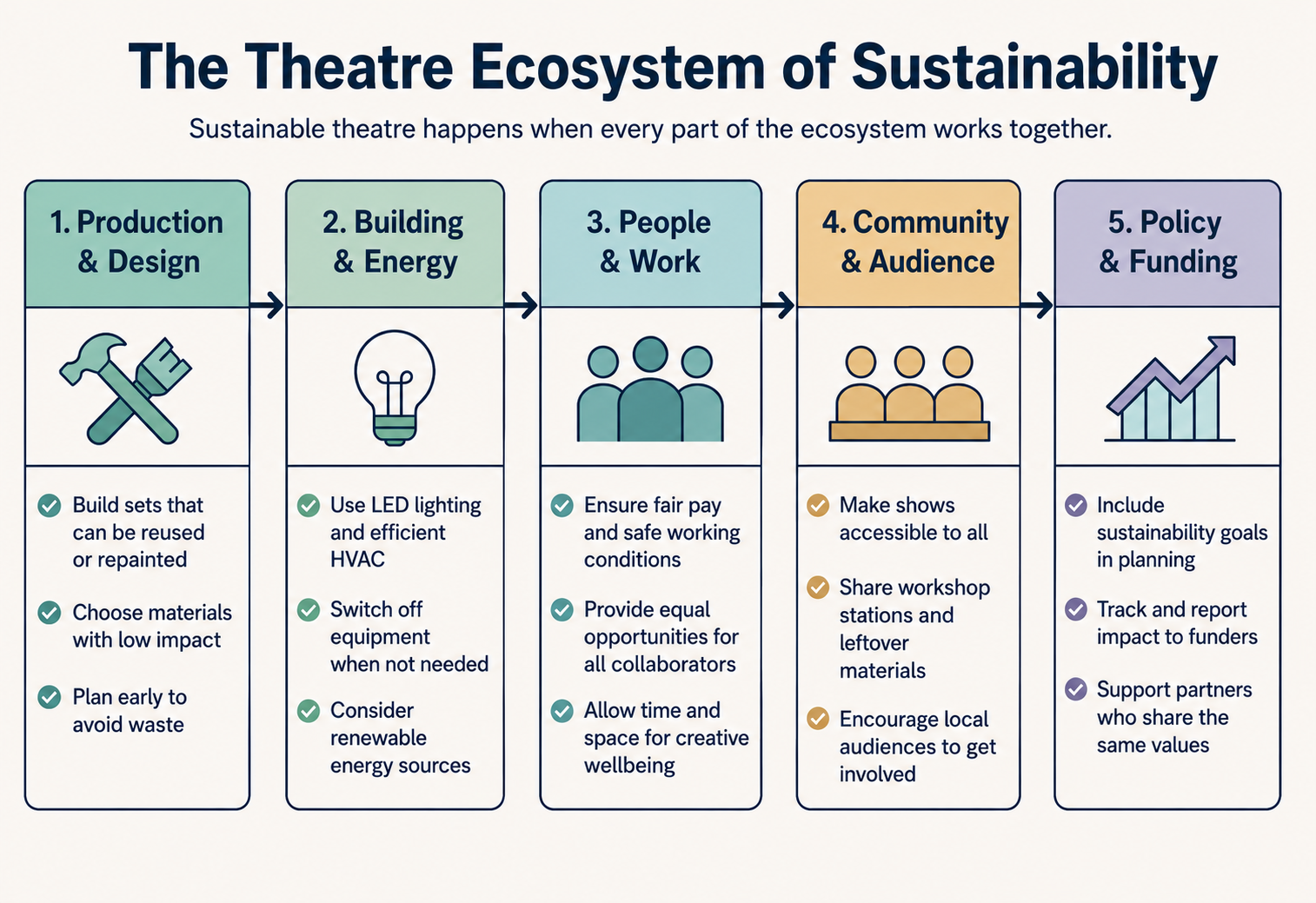
Sustainability in performance arts organisations operates as an ecosystem: choices in one domain affect outcomes across the whole organisation.
- Does your organisation currently treat sustainability as an operational issue or a strategic one?
- Can you identify whether your planning process rely on habit rather than intention?
- How is the higher administration team involved,or missing from this conversation?
- Why is sustainability a governance issue rather than a technical one?
- What is the risk of treating sustainability as a voluntary initiative?
- Who holds responsibility for embedding sustainability: boards or executives?
STRATEGIC CONSIDERATIONS
Strategic Planning, Policy & Resource Management
Sustainability becomes tangible only when it is attached to structures that guide decisions. Many Performance art organisations express sustainability as an ethical value, but very few translate that value into the architecture of planning, policy, and resource allocation. When sustainability appears in mission statements but not in financial plans or governance instruments, staff quickly will perceive it as non mandatory. A strategy becomes efficient only when it is carried through budgeting, planning and the decisions leadership maintains over time.
Strategic planning is where leadership decides what an organisation will prioritise and what it is willing to postpone or abandon. If sustainability is absent at this stage, every subsequent effort becomes remedial. are highly adept at absorbing new initiatives. However in order to adjust to envisonmentally and socially sustainable practices inherited systems are required to change. Beyond sustainability statements, pilot green initiatives, and staff training , the same production deadlines, procurement habits, hierarchy, and budget structures need to change. If not, the result is cognitive dissonance: an organisation that speaks of change while structurally preventing it. New policies are often perceived as administrative burdens. Reframing sustainability policies as enabling tools for collective behaviour helps remove uncertainty and clarify expectations. For example, a production policy may require teams to consider material reuse or energy use before designs are finalised. A procurement policy may prioritise local or shared suppliers.
A scheduling policy may require longer planning lead times to reduce last-minute, resource-intensive decisions.
These checks ensure sustainability is considered before resources are spent, contracts are signed, or timelines are fixed. Policies reduce reliance on personal motivation or individual judgement. They create a shared, consistent expectation that sustainability is part of every decision. Resources are the most honest expression of intention. Time, money, and labour allocation reveal what leadership actually values. Sustainability is not cost-free, åit requires capacity, organisational time, reflective space, and occasionally new investment. Yet the cost of not investing is greater as itexposes to reputational, regulatory, and operational risks that accumulate silently until they compromise artistic and organisational futures. By aligning sustainability policies with budgeting processes, leadership ensures that sustainability does not remain aspirational rhetoric but becomes infrastructure.
If the budget has not changed, the strategy has not changed. Resources are the most honest expression of intention.
In our art performance organisations we must also resist the idea that sustainability is purely internal. The sustainable Culture Toolkit Handbook (link) frames sustainability as a collaborative and cooperative practice, where organisational resilience increases when they coordinate with neighbours, suppliers, networks and other cultural actors . Shared procurement models reduce waste and cost. Collective knowledge accelerates innovation. Partnerships build legitimacy, reducing resistance from stakeholders who might otherwise see sustainability as ideological rather than necessary.
If sustainability goals can be achieved alone, they are not ambitious enough to transform your organisation.
A sustainability strategy starts with identifying priorities and deciding how they will be carried out. Leadership must determine which changes are needed now and which should be phased in over time. Not every organisation can retrofit a building or overhaul procurement within a year, but they can articulate what will change, when, and who is responsible. The absence of a sustainability pathway is rarely a resource issue—it is a leadership choice. Planning also requires acknowledging interdependence. Cultural organisations operate within an ecosystem of regulation, funding structures, labour expectations, civic politics, and material supply chains. Sustainability strategies that ignore these interdependencies produce isolated actions, technically correct, operationally irrelevant. Strategies that recognise these dynamics identify where influence lies and who must be engaged for meaningful transformation.
When sustainability becomes part of strategic planning, policy-setting, and resource allocation, it stops being an add-on and becomes a way of governing. Align sustainability with artistic identity may even strengthen creativity. Sustainability becomes the medium through which the organisation understands its role in the world.
- Which parts of your organisation currently set priorities without considering sustainability?
- What decisions (financial, artistic, infrastructural) could most impact sustainability in the next 5 years?
- If your sustainability goals were truly strategic, what would need to change first: planning, budgeting, or authority?
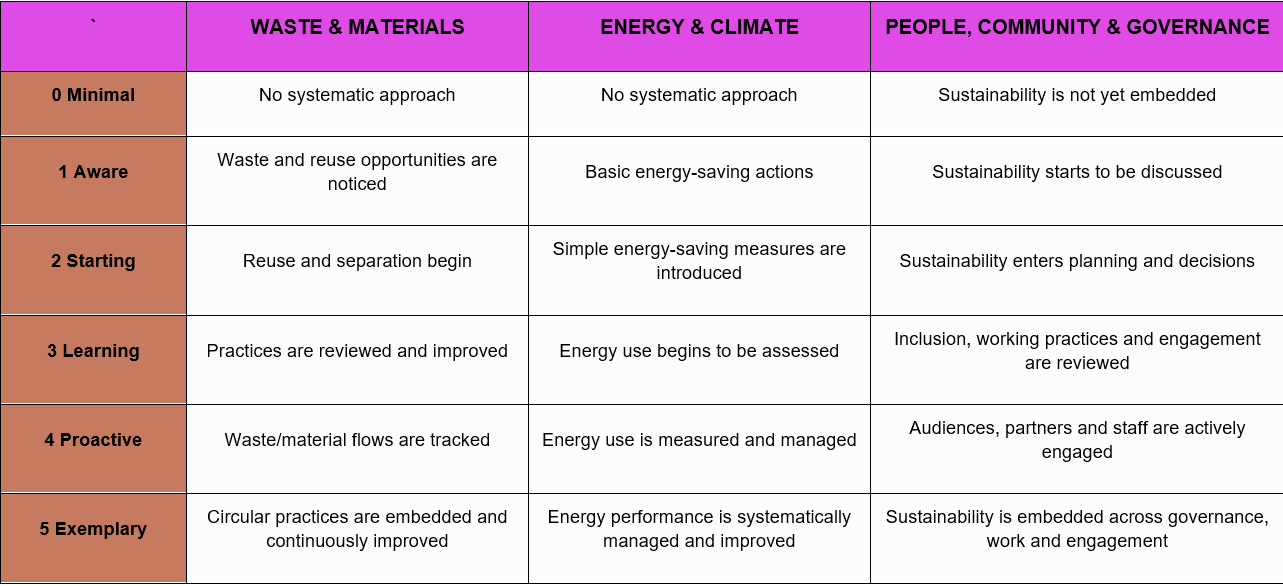
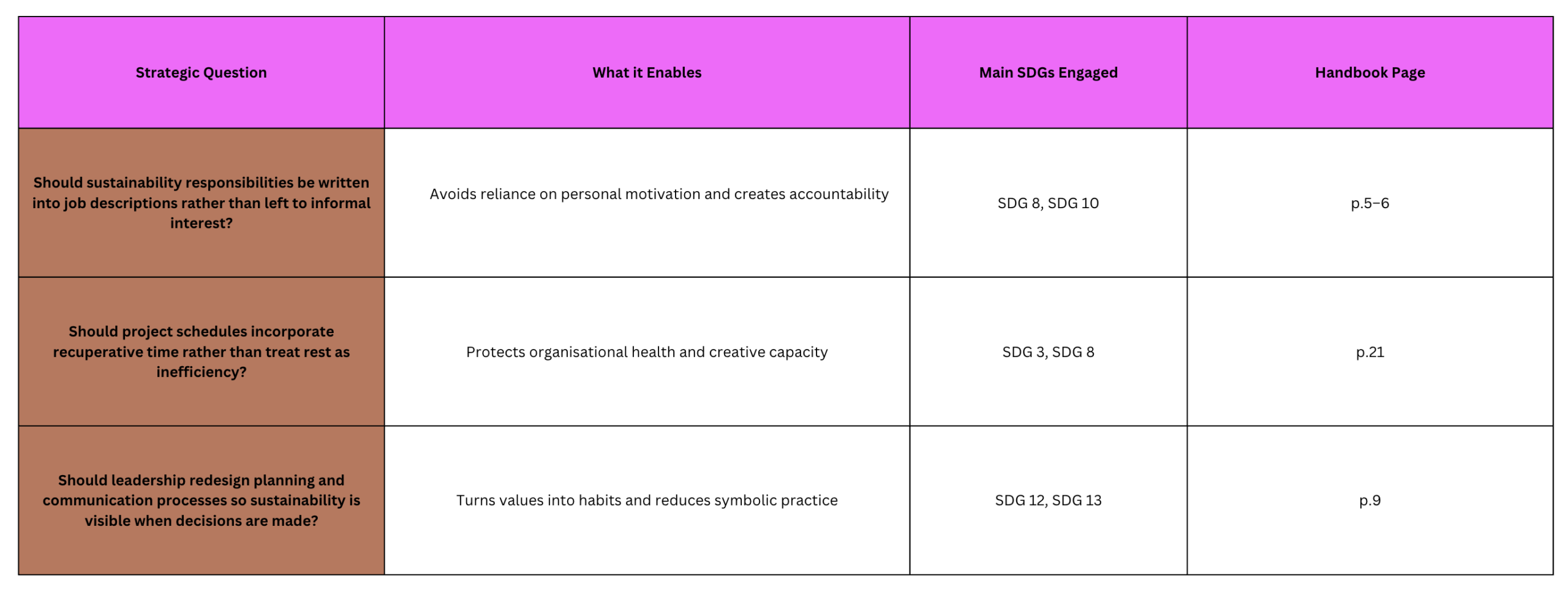
The following table tries to present a more practical view of the integration of global matters and welcomes the integration and customization to a local context. The SCT handbook (hyperlink) presents helpful examples.
STRATEGIC CONSIDERATIONS
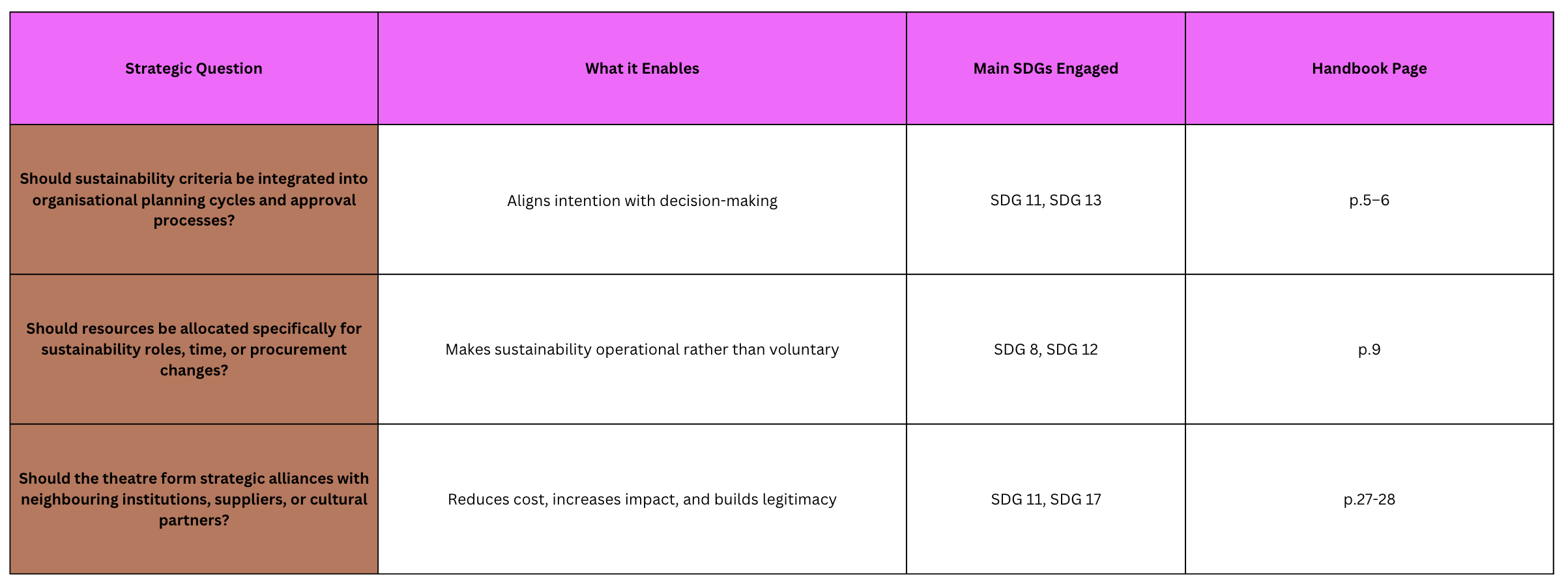
- What makes sustainability a strategic decision rather than an operational task?
- Why are policies essential for embedding sustainability?
- How do resource allocation decisions reveal organisational values?
Sustainability, SDG Alignment & Performance art organisations as Civic Actors
Organisations in the field of performance arts shape social perception and discourse. Decisions like what they produce, who they employ, how they steward resources, and how they participate in local ecosystems carry social and environmental consequences. Sustainability, therefore, is not a new obligation layered on top of artistic purpose it has already been embedded in the governance choices these organisations make. The task for leadership is not to invent sustainability, but to recognise and articulate it.
The United Nations Sustainable Development Goals (SDGs) are often perceived as external compliance mechanisms, but in practice they function as interpretive tools. They help cultural organisations understand the wider implications of decisions they are already making. Perfomance arts organisations influence workforce well-being, community cohesion, material consumption, and educational participation. These are not supplementary considerations. They part of the core work of the performing arts.. The SDGs simply provide a language for labelling those impacts.
If the SDG subgoal feels abstract, it is because it has not yet been connected to a decision you are responsible for making.
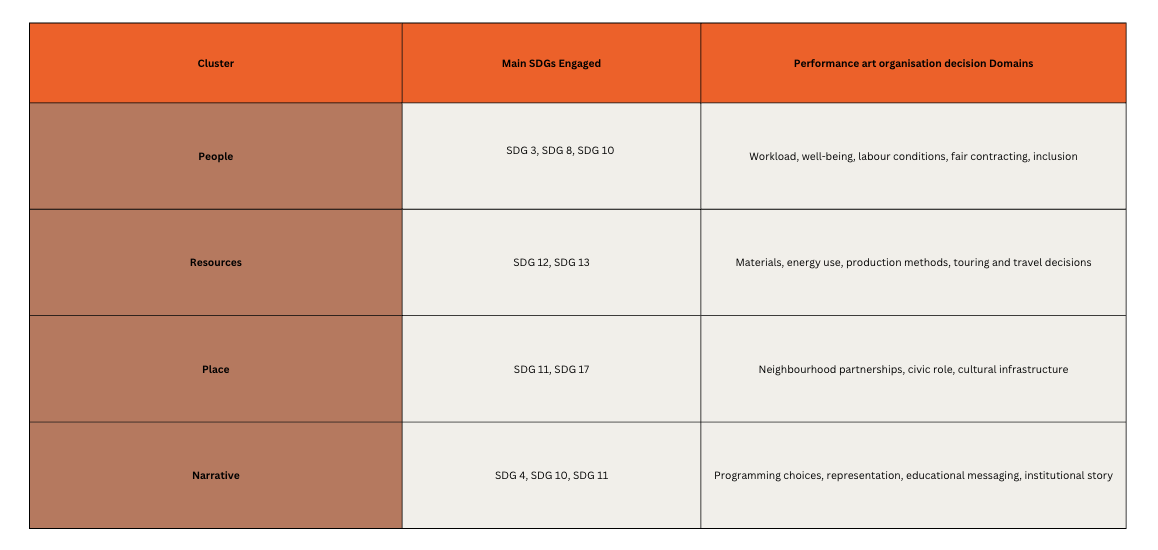
Performance art organisations frequently engage in SDG-related activity without naming it. For example, when an organisation protects staff well-being by resisting burnout culture, it addresses SDG 3: Good Health and Well-Being. When it employs artists fairly and commits to decent contracts, it aligns with SDG 8: Decent Work and Economic Growth. When it reduces material waste or shares resources, it advances SDG 12: Responsible Consumption and Production. These examples show that sustainability lives inside ordinary governance decisions, not in a separate sustainability department.
Recognising these patterns matters because it reframes sustainability from burden to advantage. Naming SDG-aligned outcomes strengthens funding applications, clarifies organisational identity, and increases legitimacy with civic partners who expect such organisations to demonstrate public value. It also reveals connections across departments. Production teams, educators, marketers, and board members often believe they work on separate tasks; the SDGs show the shared implications of their choices.
Lets stop asking whether sustainability belongs to your organisation. Ask which parts of your Performance art organization sustainability already governs.
The Sustainable Culture Toolkit demonstrates that sustainability is relational and place-based. Performance art organisations do not simply occupy buildings; they shape neighbourhood energy patterns, local economies, and social imaginaries. Neighbourhood engagement strategies ensure performance arts organisations operate as cultural infrastructures rather than isolated creative islands . Well-being frameworks emphasise that sustainability includes organisational tempo: how people are asked to work, rest, and collaborate. Material choices expose the ecological footprint of staging, design, and touring . These perspectives reveal that the SDGs are not a checklist but a lens through which to interpret organisational identity. When our organisations understand which SDGs they are influencing, they stop treating sustainability as a parallel project and start treating it as a core part of governance. The alignment then becomes intentional rather than accidental.
Sustainability, when understood this way, extends the Performance art organisation’s civic mandate. By aligning governance decisions with SDG logic, such organisations signal their role as civic actors capable of contributing to resilient, equitable, and ecologically responsible futures. In this framing, sustainability is the articulation of that identity in the real world.
SDG CLUSTER MODEL FOR PERFORMANCE ART ORGANISATIONS DECISION-MAKING
STRATEGIC CONSIDERATIONS
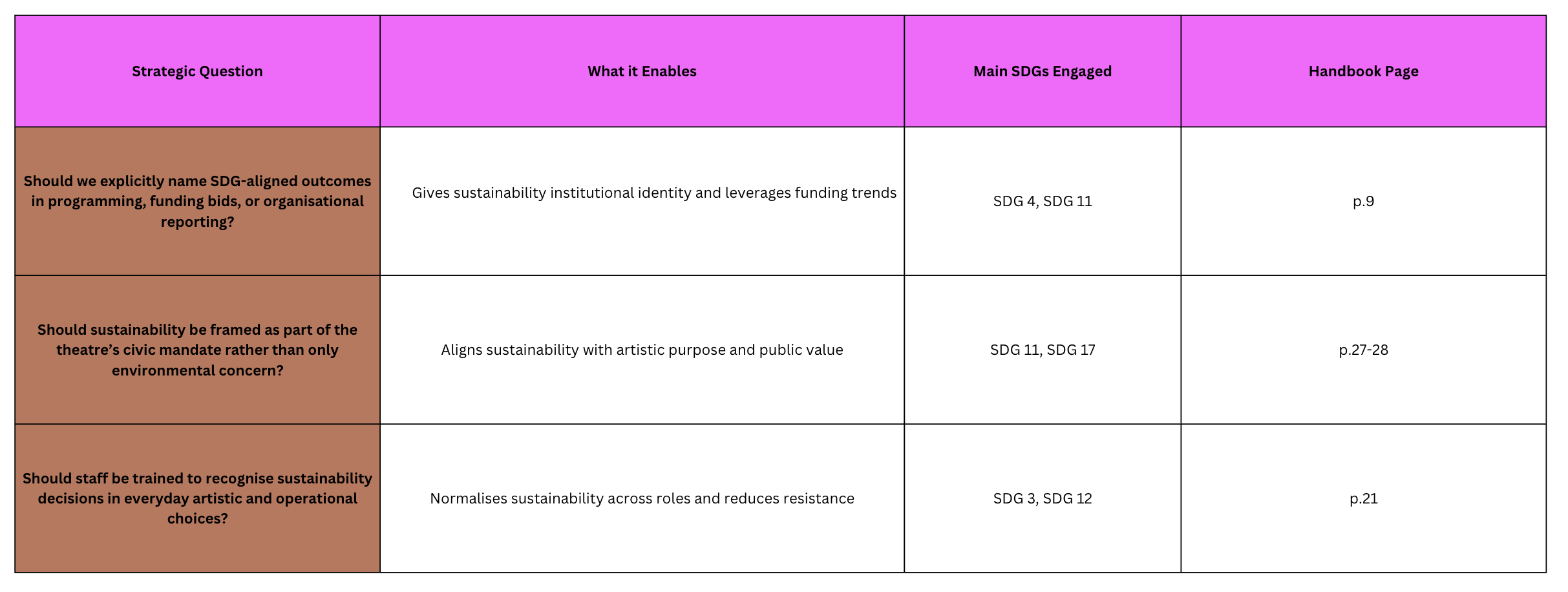
- Which SDG cluster (People, Resources, Place, Narrative) is currently driving the most decisions in your organisation?
- Which sustainability impacts already exist in your organisation but remain unnamed?
- Which decision area would benefit most from SDG language?
- Why are the SDGs relevant to your organisation and not just to governments?
- Why do SDG subgoals matter more than the headline SDGs?
- How does naming SDG alignment turn sustainability into a strategic advantage?
Leading Cultural Change & Organisational Behaviour
Sustainability rarely becomes real in a performance art centre simply because a policy has been approved or a commitment announced. It tends to take shape when everyday behaviours begin to shift. Performance art centres function as human systems, shaped by habit, pace, hierarchy, and implicit norms. When these conditions remain unchanged, sustainability often stays conceptual rather than lived. Viewing organisational culture as the pattern of behaviours that are routinely enabled, tolerated, or reinforced can help make these dynamics more visible.
Institutional culture often communicates priorities more clearly than formal strategies. People usually learn what matters by observing how decisions are made: what is accelerated under pressure, what is delayed, and what is allowed to become urgent by default. From this perspective, sustainability may struggle to rely on individual motivation or personal commitment alone. It becomes easier to sustain when it is supported by systems and shared ways of working, rather than by exceptional effort.
If sustainability depends primarily on personal energy, it may be difficult to maintain over time.
Performance art centres are already familiar with processes of behavioural change. Rehearsal is a structured way of adjusting habits, rhythms, and interactions in pursuit of a different artistic outcome. A similar approach can be explored internally. Sustainability can be understood as a process of practising organisational behaviours: experimenting with planning rhythms, reconsidering production timelines, or clarifying where decisions are made and held.
Organisational culture plays a significant role in shaping sustainable practice, yet it operates within real constraints. High workloads and compressed timelines can limit the space available to work differently. When capacity is stretched, sustainability may be experienced as an additional demand rather than an integrated way of working. In such contexts, reverting to familiar practices is often a practical response to pressure.
Well-being, in this sense, is less about removing pressure and more about considering whether expectations can be met without relying on exhaustion. Attention to planning, scheduling, and decision processes can help reduce unnecessary strain and create conditions where different choices become possible.
Well-being can be understood as part of organisational infrastructure.
Sustainability tends to become more routine when organisational systems make sustainable choices clearer and easier to enact. Shared frameworks, guidance, and opportunities to practise new approaches can support this shift, allowing sustainability to move from intention into everyday activity.
Performance art centres that explore sustainability at the level of culture often find that artistic ambition is not diminished. Instead, greater clarity, resilience, and continuity can emerge. Over time, sustainability may become less of a separate concern and more a natural part of how the organisation understands its work and its role.
STRATEGIC CONSIDERATIONS
Which SDG cluster (People, Resources, Place, Narrative) is currently driving the most decisions in your organisation?
- Which everyday cultural behaviours in your organisation may make sustainability harder to embed?
- Which teams or roles might benefit most from clearer guidance or shared frameworks around sustainability?
- What one behaviour could you personally model that might encourage a shift in organisational norms?
- Why is sustainability often better understood as a cultural practice rather than only a technical adjustment?
- How can sustainable workload practices differ from patterns that lead to burnout?
- How can modelling behaviour influence organisational change differently from announcing commitments?
FINAL TASK : Sustainable Governance Roadmap
Your learning in this module becomes meaningful only when it is converted into decisions. The purpose of this task is not to restate ideas, but to choose and commit. You will now design a concise Sustainable Governance Roadmap that translates your organisation’s sustainability intentions into governance-level action.
Write a brief roadmap that:
- States your sustainability governance intention
What future condition should your organisation be working toward? (how decisions are made, who holds responsibility, and what would be different in daily practice — not on individual projects or intentions) - Identifies 3–5 strategic priorities
These must be drawn from the module’s Strategic Considerations. (Do not invent new ideas; clarify which ones matter for your context and why.) - Names the governance structures required
Who will be accountable? Where will authority sit? What will need to change? - Addresses risks and opportunities
What might resist this shift? What capacity or partnerships will support it? - Links your roadmap to the MAIN SDGs ENGAGED
Which SDG clusters (People, Resources, Place, Narrative) does your plan activate, and how?
Your roadmap is not a proposal. It is a decision.
WRAP-UP
Sustainability in performance arts organisations is not achieved through enthusiasm. It is achieved through governance. Leadership is not measured by what it announces, but by the conditions it creates. You now have the structures, language, and decision frameworks to embed sustainability into planning, authority, and behaviour. The question is no longer whether sustainability is relevant to your organisation. The question is how you will demonstrate that relevance through the decisions you make next.
Complete the sentence below in no more than 50 words:
“One governance decision I can influence in the next 6 months that will advance my organisation’s sustainability strategy is…”
Do not choose something symbolic. Choose something real and verifiable. Once this statement exists, sustainability is no longer theory. It is your practice.
Sustainable Governance Roadmap
Your Roadmap Draft (250 words max)